
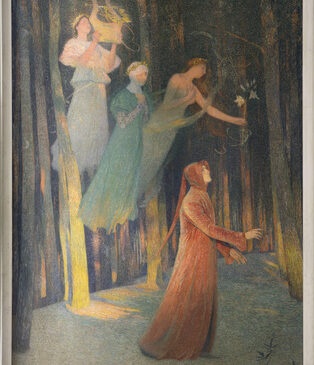
Monumental and bathed in shimmering light, Henri Martin’s Inspiration captures the elusive moment when an idea takes form. More than an allegory, it invites the viewer to step inside the very instant of creative awakening.
A Painter of Light, Vision, and Inner Life
Henri Jean Guillaume Martin (1860–1943) is often associated with Neo-Impressionism, yet his work stands apart for its spiritual sensitivity and poetic restraint. Rather than using Divisionism to pursue optical science, as Seurat or Signac did, Martin employed fragmented brushstrokes to cultivate atmosphere, silence, and contemplation. His paintings seem suspended between reality and dream, the visible world trembling with inner meaning.
Created in 1895, Inspiration belongs to a decisive phase in Martin’s career, when he moved beyond natural observation toward painting the states of the soul—emotions, intuitions, and invisible forces.
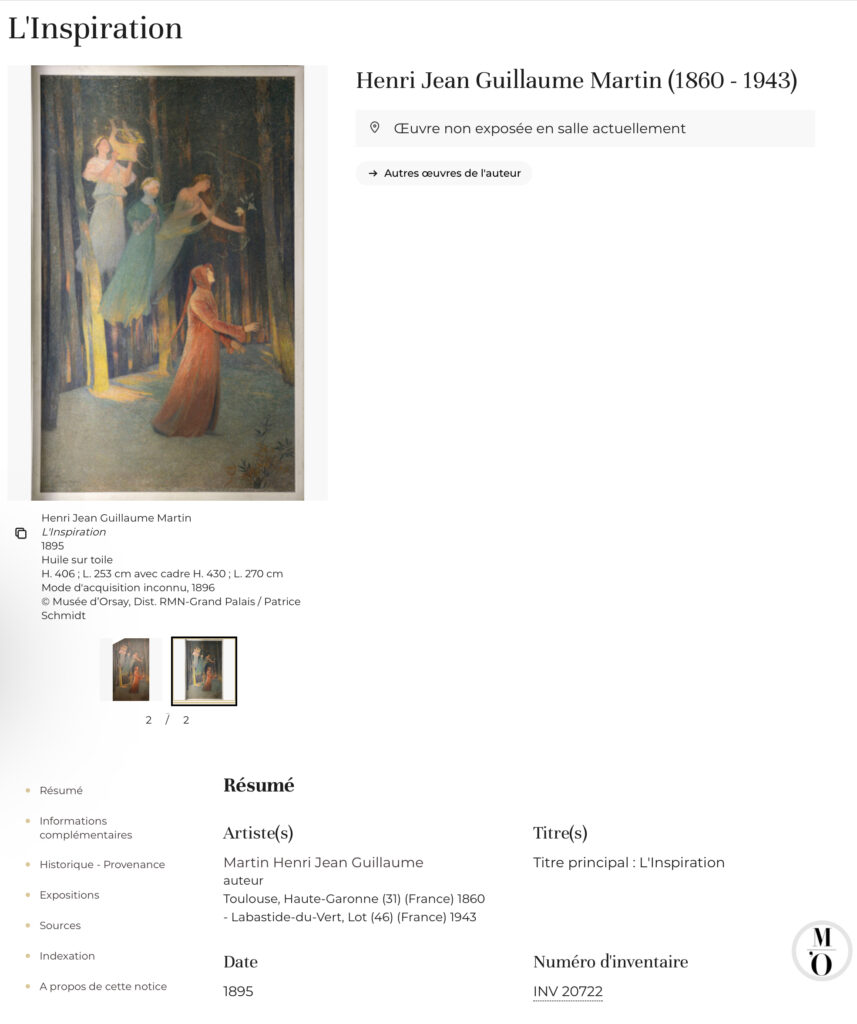
Henri Jean Guillaume Martin – Inspiration (1895)
Oil on canvas
Dimensions: H. 406 × W. 253 cm
(with frame: H. 430 × W. 270 cm)
Acquisition: unknown, 1896
© Musée d’Orsay, Dist. RMN-Grand Palais / Patrice Schmidt

A Monumental Painting of Inner Illumination
The sheer scale of Inspiration immediately sets it apart. Towering at more than four meters in height, the canvas envelopes the viewer in a serene, luminous world. At its center stands a solitary female figure—an allegorical presence rather than a portrait. She is neither entirely human nor purely symbolic, but a threshold figure: someone who belongs simultaneously to the earthly and the intangible.
The figure is surrounded by glimmering, vibrating light, rendered through Martin’s delicate technique of small, mosaic-like strokes. This enveloping radiance is not simply an effect of sunlight. It is the physical manifestation of an inner revelation, a moment when an idea suddenly becomes clear, when thought ignites into creation.
The colors—soft golds, pale blues, misty violets—avoid dramatic contrast. Instead, they generate a quiet, meditative sensation. Nothing distracts from the central experience: a person touched by something beyond sight.
Why the Title Inspiration?
The title is crucial. In the 1890s, Symbolist artists and writers were preoccupied with that mysterious instant when creativity arises. Inspiration was not viewed as a technical skill, but as:
-
a visitation,
-
a spark of the unknown,
-
a whisper from the spiritual realm,
-
a muse-like force guiding the artist’s hand.
Henri Martin, known for his introspective temperament, sought to paint not the external appearance of inspiration, but its invisible essence. The woman in the painting is therefore less a muse than the embodied moment of insight itself. Her stillness suggests concentration; her surrounding light, the awakening of thought; her isolation, the solitude necessary for creation.
By choosing this subject, Martin transforms a private mental event into a monumental vision, suggesting that the birth of an idea is worthy of the same scale and reverence as historical or mythological scenes.
A Work Deeply Rooted in Symbolism
Symbolist painters aimed to reveal what lies behind outward appearances. Instead of describing the world, they sought to suggest, evoke, and hint at the ineffable. In Inspiration, Martin uses Divisionist light not for scientific precision but for emotional resonance. Light becomes metaphor—radiance as revelation.
The absence of narrative detail also aligns with Symbolist ideals. There is no specific environment, no temporal markers. The painting exists outside time, representing a universal experience: the human encounter with the creative impulse.
Conclusion: A Meditation on the Creative Spirit
Inspiration is one of Henri Martin’s most profound works, a painting that transforms an intangible psychological event into a vast, luminous vision. Through its monumental presence and shimmering brushwork, it invites viewers to experience not the depiction of inspiration, but the feeling of being inspired.
More than a simple allegory, the painting is a meditation on the quiet, transformative moment when an idea emerges—fragile, radiant, and full of possibility.
Subscribe on social media and email list to get artsy and travel updates, as well as get 15% off the Shop (yes, we have a Creative Shop)!